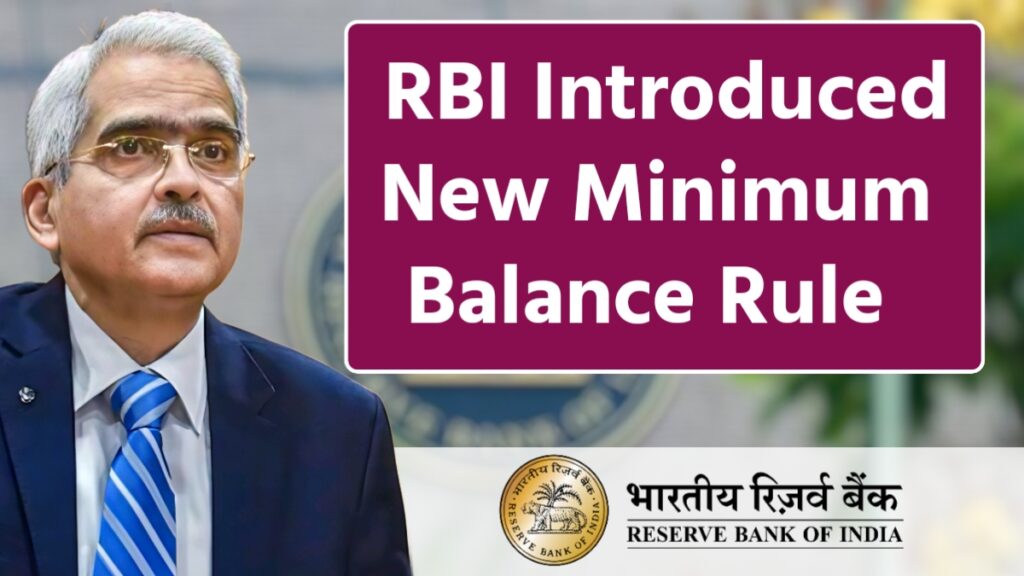
RBI Minimum Balance Update 2026: The RBI Minimum Balance Update 2026 may not have arrived with dramatic headlines or emergency announcements, but its impact is being felt across bank branches, mobile apps, and kitchen-table financial planning conversations. For years, minimum balance penalties have been a sore point for ordinary account holders especially those with uneven incomes, sudden expenses, or limited savings buffers. Even small shortfalls often triggered automatic deductions, leaving customers frustrated and distrustful of the system.
Against this backdrop, the Reserve Bank of India’s latest push toward fairer balance norms marks a shift in philosophy. Instead of treating low balances as a fault, the new framework nudges banks to see them as part of real life. By discouraging harsh penalties, revising balance thresholds, and insisting on clearer communication, RBI is attempting to make basic banking less intimidating and more usable. The RBI Minimum Balance Update 2026 matters not just for what it changes on paper, but for how it reshapes the everyday relationship between banks and customers.
Why RBI Stepped In After Years of Complaints
The roots of the RBI Minimum Balance Update 2026 lie in years of customer grievances. Banking ombudsman reports and consumer forums repeatedly flagged complaints about sudden deductions that customers often discovered only after checking statements. In many cases, the penalty amount itself was small, but the lack of warning or explanation made it feel arbitrary. For low-income households, even minor deductions disrupted monthly budgeting and eroded trust in formal banking.
Regulators also noticed a worrying pattern: inactive or abandoned savings accounts, particularly in rural and semi-urban areas. Many account holders preferred cash over banks simply to avoid penalties. According to a former RBI advisor, “When fear replaces confidence, financial inclusion suffers.” The 2026 update can be seen as a corrective response less about generosity, and more about fixing a system that was unintentionally pushing people away.

No-Penalty Push and the End of Automatic Deductions
One of the most discussed aspects of the RBI Minimum Balance Update 2026 is the clear push against blanket penalties. While RBI has not outlawed minimum balance requirements altogether, it has strongly discouraged automatic and excessive charges, especially for basic savings accounts. Several public sector banks have already moved to eliminate penalties in entry-level accounts, signaling compliance rather than resistance.
This shift has practical consequences. A daily wage worker whose balance dips temporarily is no longer immediately penalized. Students and pensioners, too, gain breathing room during months of unexpected expenses. Banking experts note that this approach aligns with RBI’s broader inclusion goals. Instead of policing accounts, banks are being nudged to support continuity and usage—keeping accounts alive rather than profitable through penalties.
Revised Balance Limits Reflect Real Living Costs
Another major element of the RBI Minimum Balance Update 2026 is the recalibration of balance thresholds. Earlier norms often applied uniform expectations across vastly different regions. Under the updated framework, banks are encouraged to set more realistic minimum balances based on whether an account is urban, semi-urban, or rural. In several categories, the required amount has been quietly reduced.

This matters because costs of living vary sharply across India. A ₹3,000 balance may be manageable in a metro salary account, but unrealistic for a rural household dependent on seasonal income. By acknowledging this gap, RBI has injected a degree of economic realism into policy. Analysts believe this flexibility will also reduce the pressure on banks to cross-subsidize through penalties.
Rural and Small-Town Customers See Tangible Gains
For rural and small-town customers, the RBI Minimum Balance Update 2026 feels less like a regulatory tweak and more like overdue recognition. In the past, penalties often discouraged people from using accounts actively, even when government benefits were routed through them. Dormant accounts became common, undermining the purpose of financial inclusion drives.
With relaxed norms, these accounts are now more likely to remain active. Farmers with irregular cash flows, self-help group members, and small traders can maintain accounts without fear during lean months. This also strengthens the delivery of welfare schemes, as fewer accounts risk becoming inactive. Economists point out that inclusion works best when rules adapt to people, not the other way around.

Urban Customers, Transparency, and Smarter Choices
Urban account holders have not been left out of the RBI Minimum Balance Update 2026, though the changes are more nuanced. Premium and salary accounts still carry balance expectations, but banks are now required to be far more transparent. Charges must be disclosed clearly, and customers must receive alerts before penalties are applied.
This transparency changes behavior. Customers are better positioned to compare account types, switch to zero-balance options, or consolidate accounts. A Mumbai-based retail banking consultant notes that “informed customers are less likely to feel cheated.” Over time, this could push banks to compete on service quality rather than relying on penalty income.
Digital Banking and What Comes Next
The RBI Minimum Balance Update 2026 is also expected to quietly accelerate digital banking adoption. When customers are less worried about maintaining exact balances, they are more comfortable using UPI, online transfers, and mobile apps. Reduced fear translates into higher transaction confidence, especially among first-time digital users.

Looking ahead, policy watchers expect RBI to monitor how banks implement these norms in practice. Further standardization, clearer grievance redressal, and tighter disclosure rules could follow. While the update does not solve every banking frustration, it signals a regulatory mood that favors usability over punishment—a notable shift in India’s banking landscape.
Disclaimer: This article is based on publicly available information, regulatory guidelines, and industry analysis related to the RBI Minimum Balance Update 2026. Banking policies may vary by institution and account type. Readers are advised to check with their respective banks or official RBI communications for the most accurate and up-to-date details. This content is intended for informational purposes only and should not be treated as financial or legal advice.